The Company that Embodied Better with Age
The best details of this piece come from the book “You Don’t Know Jack or Jerry”. Special thanks to Rame Adi for securing me a copy.
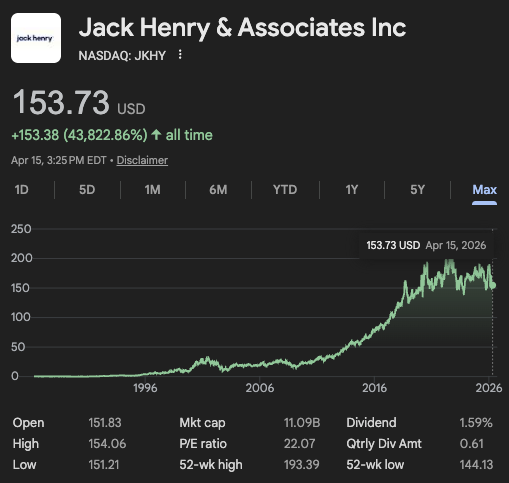
The stock returned >475x since its 1985 IPO.
Constellation Software (a 100x stock) called it “our Gold Standard for VMS Businesses”.
Their out-of-print book sells for >$1,000 in the used market. (Thank you, Rame!)
There are plenty of“clickbait” reasons why Jack Henry (JKHY) might intrigue the business community. But what I love most? They actually lived their motto for decades: “Do the Right Thing, Do Whatever It Takes, Have Fun”
Here’s my best attempt at a simple overview of Jack Henry. It was founded in 1976 to offer technology (software) solutions for small and mid-sized banks. Today those solutions equate to a full operating system (accepting deposits, making loans, and running the general ledger). It’s not embellishment to say, if Jack Henry software fails, the bank can’t run. That offering of critical infrastructure also translates into an attractive business model: over 90% of their revenue is recurring, customer retention is 99%+ over 30 years, and when a bank decides to switch providers, Jack Henry wins 50% of those opportunities.
What I love most about Jack Henry is that the company did it their own way. They didn’t take themselves too seriously. And they looked like they were having fun.
Coincidentally, a man named Jack Henry was the founder of Jack Henry. He didn’t do it from his Stanford dorm room. He was 35 when he took over as Operations Manager at Gillioz Bank in Missouri. He was installing third party software and realized “it wasn’t worth sh*t, it was really bad stuff”. More importantly “I’d better learn programming pretty quick or I’ll sacrifice losing my job”. I am skipping forward but you can guess, this led to the founding of Jack Henry & Associates.
Jack Henry founded the namesake business in Monett, Missouri. The office was across the street from Joe’s Barber shop and rented for $40/month. They moved to a second office, also in Monett, in a tire shop. Maybe you admire the Ozarks, but you wouldn’t call it a hotbed for software startups.
As Jack Henry expanded nationally, competitors used their Missouri roots against them. Rather than succumb to pressure, I really love that the company anchored down. They ran advertisements such as “Monett is not the end of the world, but you can see it from here.” And locally, they ran an advertisement:
“We are a high-tech company. Most companies with that classification come from Silicon Valley. Our visitors frequently ask:
Where do you find your talent? We thought we’d show you where we found them:”
The rest of their advertisement is a list of their employees and the local high schools they attended.
I am a huge believer that disadvantages always have a silver-lining advantage to exploit. When trying to get a job on Wall Street from James Madison University, I did not have a front-door entrance. But guess what? Every alumni that did work on Wall Street REALLY wanted to help me get there. It requires execution, for me that was scouring through alumni databases and creative Google Searches just to do cold outreach, but that worked in my favor. And Jack Henry played into it.
“Identify a problem and solve it” is a common motto for starting a business. Jack Henry took this a step further by ensuring every solution had a measurable economic benefit to the banking institutions AND the banks’ customers.
This was true of his first overdraft software he developed for his previous employer. And Jack quickly followed with Customer Information File (CIF) software. Before the CIF, a loan officer had no way of knowing whether a prospective client had $50,000 in assets at the bank, and might decline a $10,000 loan. The result: better customer service and more economic opportunities for JKHY customers.
As much as we can simplify business in frameworks, the variables associated with a sale are endless. In the early years, customers were worried about installing software from a startup.
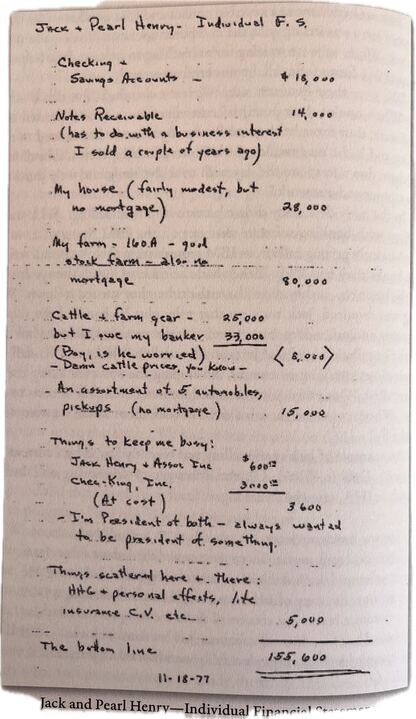
Why attach yourself to a business that might not be around in the future? In a meeting with Jones National Bank, this was the fear. Jack took out a notepad and shared his individual financials (pictured below) with the customer. Jones National remains a customer 49 years later. I will remember this next time I say “Let me get back to you on that during a meeting”
In another version of “scaling tips can be described easier than they are executed”, Jack assumed he’d install software and train bank employees, then move on to the next customer installation. “I thought it would it would be a series of one-night-stands.” But customers required ongoing support and importantly: Jack Henry began to charge hourly for those services.
When there was value being provided to a customer, Jack Henry collected an appropriate share for themselves.
The greedy devil on your shoulder might lust over the stickiness of the revenue stream… and the potential for tacking on fees. But the business was truly built around customers – an early installer noted co-founder Jerry Hall had a (angel on your shoulder) motto:
“Take care of the customer, we’ll worry about the billing later. We may get our money out of it or maybe not, but we’ll get the customer taken care of.”
Meanwhile, they were always one bad install away from going hungry. To this day, Jack Henry does not force unreasonable pricing power. It’s not hard to find anecdotes of customers were willing to pay 20%-30% more than where a new contract priced. This willingness to share economic value is a major factor in the durability of the business.
An “AI definitely didn’t write this” motto.
I mentioned Jack Henry was founded with 3 core pillars:“Do the Right Thing, Do Whatever It Takes, Have Fun”.
But rather than focus on the pillars themselves, consider that slogan. It doesn’t roll off the tongue. It doesn’t fit an acronym. A branding agency might shriek in horror. It was clearly written by people focused on the spirit of the ideas rather than the packaging. Those pillars remain in place today – and focus remains on employees and customers.
“We are going to have to work harder and get paid less for it.”: A note on being REAL with your people
Jack Henry was profitable from Day 1. Co-Founders, Jack and Jerry, paid themselves a salary of $12,000, and funded all growth from their balance sheet. They drove to customers, worked until 3AM on installations, and then wokeup and drove to the next installation.
Their sales proposition was clear but let’s not overlook the financial hygeine and adapting of incentives. As they grew, they needed a team to make installations. With a small team, JKHY knew that employee satisfaction was paramount to customer satisfaction. They were asking a lot of employees and made sure a % of the installation cost went directly to the installers.
This program had employees with $35,000 salaries getting paid a $90,000 bonus. And eventually, Jack Henry had the capital to hire a proper support staff, the bonus program was adjusted down to account that there would be fewer 3AM nights. Yes, employees can be endlessly greedy about pay. Yes, employers can be endlessly fickle about pay. There is something to be said for building a track record of transparency and clear alignment on these issues.
That track record builds a foundation. At the end of the day, it’s easy to mistake “winning” as “good culture”. It’s moments of struggle that put culture to the test.
In 1987, JKHY moved from exclusively partnering with IBM and signed a contract with Unisys. The goal was to have a partner that was aligned with JKHY, rather than having to compete with every other vendor using IBM. It did NOT work out – and in 1989 that decision was reversed with legal proceedings required. Jack told his team
“We are going to have to work harder and get paid less for it.”
Jack Henry’s early culture earned loyalty with the employee base. A sales associate, Rick Crawford, recalls that announcement:
“We got pretty accustomed to big bonuses. This was the first time they wouldn’t be paid. But I never went looking (for a new job), and it was absolutely the right thing to do. Any time we had a tough time, Jack and Jerry would find a way to make up for it.”
Rather than receive his $16,000 bonus, Rick Crawford received stock, which was worth $1.3mn when he sold it in 2006, and $12mn in if held as of 2025.
And in 1992, three years after the IBM/Unisys reversal, the court battles were over. Management thanked their team and noted “in retrospect, the event probably represented a turning point which brought out the best in all of us and made us a stronger company”. Every employee that stuck around since 1989 also received an additional cash bonus.
Throughout this time, they ensured that customers were satisfied, but management KNEW this was only possible with a satisfied employee base.
M&A: Learning by Doing
Jack Henry made several acquisitions with proceeds from their 1985 IPO. When asked about their initial strategy, Jack Henry noted
“I wasn’t aware we had a strategy. We had a goal to grow 20% per year.”
It took a bad integration in 1991 to change that tune. After acquiring Bankers Own Software System (BOSS), they moved the employee based to Monett, stopped marketing BOSS, and told customers they’d need to covert to Jack Henry software. All but 2 employees quit and the customers were not happy. In future acquisitions, they found ways to keep employees at their home base and slowly transition software.
M&A in the 1990s was key to JKHY’s success. They acquired 15 companies – most notably core software competitors which helped consolidate the market and add a new client base. Only 1 of 15 was not successful, and all acquisitions were made without debt.
The M&A program has continued but now focuses on its added and add-on solutions. These represent small bolt-on offerings that complement the core offering. This nuance is important because integrating core software is a tall task. Jack Henry operates with 2 core software solutions, while most competitors operate with >8, many of which have zero integration and zero innovation.
In contrast, add-on solutions and added-services can be cleanly integrated reducing the friction and operational pain typically associated with serial acquirers.
Let’s Talk Abount (Corporate) Politics
For the 10 year period ending 12/31/00, JKHY ranked #2 in stock performance – 76.8% compounded annual return (and for the trivia fanatics, EMC was #1). Management did not shy away from reality – they were bigger and that means things change. In 2003, management wrote to employees:
“We’re not the same company we used to be. You have more layers of management so bureaucracy and politics try to sneak in the door. But getting bigger is not only a product of progress; it is a necessity for survival. Growth brings plenty of good things too…. something that is very important to me – organizational continuity. Our success doesn’t rely on one or two people. We can weather tough times. A company can get bigger without losing its culture or way of doing business.”
And again in 2003, they cemented their focus on customers:
“Ever stop to really think about what business you’re in? Here is a one questio: If all of your customers went away for good, would you still have a business? Would you still have a job? Of course not. That’s the most important thing you do: YOU’RE IN THE CUSTOMER SERVICE BUSINESS”.
Today, employee satisfaction remains high. If Glassdoor rankings are worth comparing, their employee score ranks above 4, higher than their closest competitor’s below 3. They consistently rank as one of the best places to work. Customer satisfaction scores are also high, 4.8 on a 5.0 scale. They publicly publish these scores.
Customer Obsession sounds great, but what does it actually mean?
Many companies claim to be customer-obsessed – but it’s always worth asking “what have they done to benefit the customer that is to their own detriment?”
Today, Jack Henry’s core banking software accounts for ⅓ of revenue. The added solutions (e.g. debit cards, allowing customers to make payments, etc.) account for ⅓ of revenue. And add-on services (fraud, treasury, etc.) account for the final ⅓ of revenue.
Today, the core business grows organically in the mid-single digits. But this is the lynchpin of their relationships, and they spend 15% of revenue on R&D to ensure that the offering evolves with customer needs.
Most importantly, rather than make their offerings closed off, Jack Henry incentivizes third-party fintech providers to plug into their solution (issuing 2 million tokens last year). This open architecture might mean they don’t sell the Jack Henry solution to the customer – making it easy for the bank to choose a third-party solution. This is a perfect example of customer obsession. While this sacrifices short-term profits, it keeps customers satisfied while ensuring the durability of their core product.
Always Remember: Valuation Matters
For all of the accolades of Jack Henry, a business is not a stock.
From 2000-2010, JKHY compounded revenue at 14% and EPS at 21%. The shares underperformed the S&P. Why? JKHY shares traded >50x EPS heading into into the decade.
In the past 5 years, JKHY revenue and earnings have compounded at mid-single digit rates. But shares have essentially been flat. Again, a premium valuation is driven by high expectations.
What is the lesson here? It’d be easy to chase share price performance, but that would not fit the cultural DNA. By remaining focused on customers, Jack Henry’s continues to show healthy operating performance. This keeps the stock atop many “wishlists” for market selloffs – and ensures they will be around for decades to come.
Closing Thoughts
The book – “You Don’t Know Jack… Or Jerry” – was published in 2008. If you happened to ask the company about extra copies, you might get a funny response: “We couldn’t give it away. It’s hilarious that people want it now.” The storage boxes survived several moves – “they are around somewhere”. After months of chasing, you might get your copy.